How Do Congressional Democrats and Republicans Talk About The Environment?

An analysis of common phrases in the titles of Congressional environment committee hearings.

By Abigail Mihaly

It's no secret that Republicans and Democrats talk about climate, energy, and the environment differently.

During a speech to the United Nations last fall, President Donald Trump called climate change "the greatest con job ever perpetrated on the world.”

This is in sharp contrast to lawmakers pushing for policies that could help avoid the worst impacts of climate change. Many Democratic lawmakers, such as longtime climate advocate Sen. Ed Markey (D-MA), call climate change a "crisis" and an "existential threat."

And yet — despite serious disagreement on the substance of the topic — Congress, regardless of which party controls, has to do the core work of energy and environment lawmaking. That includes energy and environment issues.

Four House committees are charged with most environmental issues: the House Energy and Commerce, House Natural Resources, Senate Environment and Public Works and Senate Energy and Natural Resources Committees. Examining the titles of these committees’ hearings is a great proxy to consider: how do Democrats versus Republicans talk about and prioritize these issues?
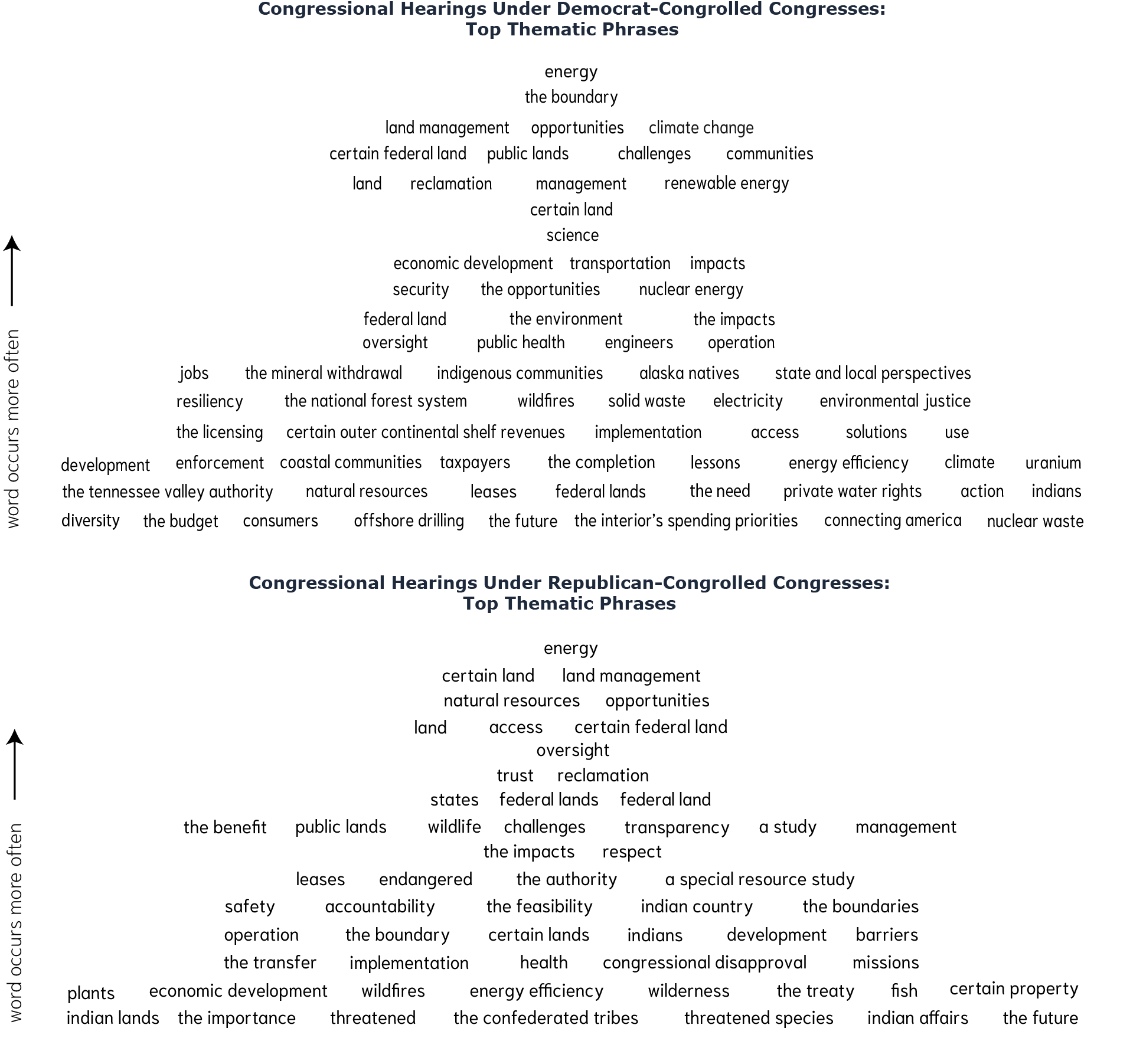
Here are the most common phrases each party used to title Congressional hearings in the last decade.

Because this analysis looks at the most common topics, I've stripped out places, people and legislation so we can take a look.

“Climate change” appears only on Democrats’ list.

Many Republicans do not dispute the existance of climate change, but argue it isn't a top issue. Secretary of the Interior Doug Burgum, who is in charge of policies baout natural resources, says the U.S. should do everything it can to build more data centers to power artificial intelligence, pushing back on arguments from the left that AI’s power consumption is a major problem because of its potential to worsen climate change.

“The real existential threat right now is not a degree of climate change,” Burgum told Politico's E&E News. “It’s the fact that we could lose the AI arms race if we don’t have enough power.”

Republicans' list of top terms doesn't include "renewable energy." Republicans generally prioritize fossil energy over wind and solar. Some types of energy have drawn support from both sides, like nuclear and hydropower. The term "electricity" also appears on the Democrat's top term list, but not Republicans', reflecting Democrats' push for electricity-based energy like electric vehicles and heat pumps.

Meanwhile, the term "natural resources" appears higher on Republicans' list of top terms. Natural resources includes fuel extracted from the earth, or mined minerals

But Demcorats are also naming their committee meetings with the term enough to make the list. Mineral withdrawal also appears in Democrat committee hearing titles

Moving beyond energy types, Democrats frequently use words about community and local perspectives that are absent from Republicans' list. For example, the then Democrat-controlled House Natural Resources Committee held a 2020 meeting titled “Environmental Justice for Coastal Communities: Examining Inequities in Federal Grantmaking.”

Terms like "environmental justice" are increasingly criticized by the Right. As part of his anti-DEI (diversity, equity and inclusion) crusade, Trump has targeted programs, agency offices, and grants with such terms. In March 2025, the Environmetnal Projection Agency announced it “cancelled grants and contracts related to DEI and environmental justice.” A federal judge reinstated them in June, 2026. "Diversity" also makes the Democrats' top terms list, but does not feature on Republicans'.

Although terms "communities" do not appear on the list of most common title terms under Republican rule, though references to Indian land and peoples do feature. Also, "Indigenous communitites" is used more frequently than "Indians" in Democrat-controlled congresses.

In Republican congresses, meanwhile, wildlife-related terms are more common than in Democrat-related Congresses.

This fits with a longstanding understand of Republican outdoorsmanship. Rep. John Curtis, a Republican from Utah and chair of the conservative climate caucus, for example, frequently seeks to connect with conservative constituents by talking about going walking and fishing. "One of my long-term goals is to have every Republican talking about being good stewards, leaving this Earth better than we found it," Curtis told The Cool Down. "And in truth, I think we always have, but we talk about it in a different way," Curtis told The Cooldown in 2023.

Simply looking at phrase frequency can remove context. For example, frequency of the word "endangered" may not only indicate bills to protect wildlife. In the context of Congressional hearing titles, "endangered" often refers to the Endangered Species Act. Some Republican-led committee meetings with the word "endangered" in the title offer bills that would increase the hurdles to list an endangered species.

Still, the trends found in environment committee Congressional hearings offers clear differences in how the two major parties talk about environmental issues: Democrats say climate change is an existential threat requiring investment in clean energy now. They focus on the community-level impacts of both climate change and traditional pollution. Republicans, meanwhile, dismiss or downplay climate issues. They instead focus their attention on traditional conservation while supporting industrial and fossil fuel development.